 Details
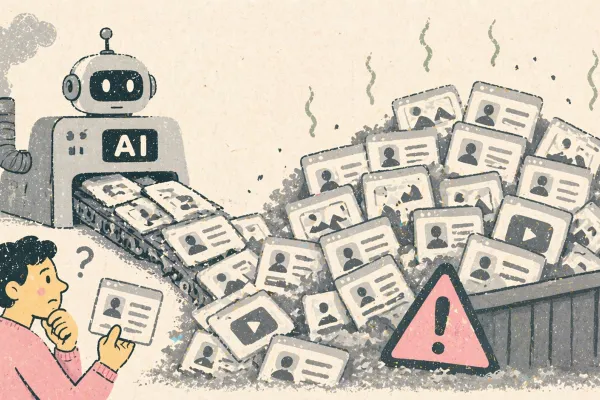
You know that creepy crawly feeling when you watch an AI-generated video or read an article that feels like it was churned out by the "humans” in Pluribus? It’s not just you.
Following a surge of AI-generated content in 2025, audiences are pushing back against “AI slop”. Maybe it’s due to an unease around software replacing human creativity. It could be that we want to get our advice from trusted experts and not error-ridden AI search engines and chatbots. And don't get me started on the uncanny valley.
Whatever the reason, publishers, advertisers and content creators need to take notice: digital audiences simply don’t trust AI-generated content.
A recent study by Raptive revealed that readers’ trust drops by 50 per cent when they suspect an article was created by AI. Data from Nielsen reveals similar results. In a survey on sentiments toward AI, 55 per cent of respondents said they feel uncomfortable on websites with significant AI-generated content.
For advertisers, this creates a whole new brand safety concern. If your content appears on a website next to AI generated content, it can damage your campaign’s performance, not to mention how your target audience feels about your company.
We've seen these placements impact sales, too: purchase intention drops 14 per cent for products that appear in the same online environment as suspected AI content.
These statistics aren’t surprising. Consumer trust in AI has steadily fallen since 2019, even as more people use it in their everyday life.
Just because AI content resembles something a human would make, that doesn’t imbue it with value.
To paraphrase the old adage, if it looks like a duck, swims like a duck, and quacks like a duck, that doesn't necessarily mean it's a duck.
But while the topic has been a growing concern for many, it also presents an opportunity for publishers who have built a legacy on offering readers valuable, trusted content – and the advertisers who partner with them.
For instance, Canadian news publishers as a whole are seen as 35 per cent above the baseline level of trust when compared to non-publisher sites and social media, according to a recent report by News Media Canada.
For advertisers, creating sponsored content with a publisher (and steering clear of AI content) allows them to borrow that organization’s credibility. In fact, brands saw a 25 per cent increase in brand lift when their ads were associated with trusted publishers.
Publishers are set up to become a last bastion of credible, trustworthy content – which makes
advertising on those sites more valuable than ever before.
This is why the rise of AI shouldn’t concern, but instead galvanize sponsored content creators. Our work is more valuable than ever, and we can ensure its continued success in a digital environment filled with AI-generated content through authentic and unabashedly human tactics. Quack quack.
Be yourself
Audiences trust content more if it is created by a real person.
This means the author is more important than ever – and will continue to be as AI-generated content becomes harder to spot.
When creating anything for an audience, shout your credentials from the rooftop. Add bylines to articles. Share profiles of your team members on LinkedIn and social media to build your content studio’s credibility. By emphasizing the content's authorship, you in turn emphasize its credibility.
The second part of this is to involve real people as the subjects of your stories. At Content Works, the interview is the heart of our storytelling, and a great interview often inspires our team to take the content in unexpected directions.
I also take inspiration from content juggernauts like TBrand at the New York Times, which consistently puts human beings at the centre of their content executions. A recent paid post by Belmond, titled “Life on a Train”, shared travellers’ first-hand experiences as they journeyed along the company's luxury train lines.
Be bold
Much of the AI content we see on the internet is filled with cliches and stereotypes (not to mention false information). As a result, it can quickly feel soulless and generic.
Branded content can distinguish itself from the rabble by being radically original. Better yet, the framework of authority from reputed publishers offers a foundation from which advertisers can push their creativity further.
One example comes from Plotfish, a branded entertainment studio in Belgium, which partnered with the Belgian Alzheimer’s League to write and stage “Sense”, a musical about dementia. The performance raised awareness about memory loss in a way that felt authentic and tugged the audience’s heartstrings.
BBC Storyworks had an innovative solution to help promote the Samarkand Marathon, which aimed to raise awareness of its status as Central Asia’s premier long-distance running event. The content studio programmed an interactive game that challenged players to take on the Silk Road Run, during which they learned about the marathon and Uzbekistan as a destination.
In your content executions, pursue topics that no robot ever could. Write a screenplay, start a radio show, or build a video game.
Explore your author’s voice. Find the turns of phrase that are uniquely you, then turn them up to 10. Invent new metaphors. Be silly, be messy.
If your audience is curious about what you’ll say and do next, you’ll also keep them engaged for longer.
Be smart
It would be very “old man shakes fist at sky” of us to discount the usefulness of AI. It has been widely adopted by marketers across all fields, and content creators shouldn’t let themselves fall behind out of principle.
That said, the golden rule seems to be: use AI to give you more time to be creative. Engage AI chatbots to spark ideas or expand thought starters. Create mockups of eventual products to help sell the dream to clients.
And sure, it can be tempting when, with just a few taps of the keyboard, that same AI could spit out an article and save you hours of thinking, researching and writing. But isn't that the point?