 Details
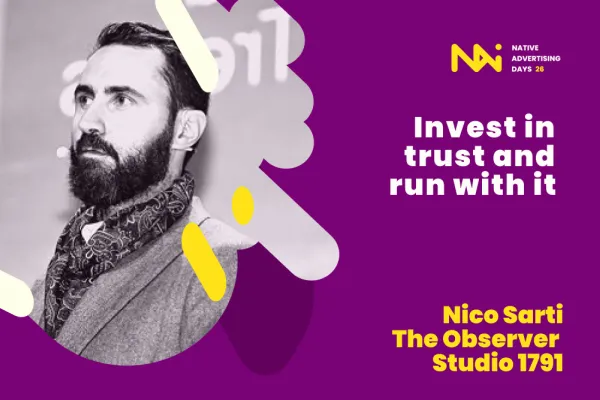
In the next of our Speaker Spotlight articles, we heard from Nico Sarti, Head of Studio1791 at The Observer, who has over 20 years of experience leading integrated campaigns and brand strategy for world-class companies. With a priority on authentic cultural connection and a vast wealth of experience, his insights on the state of the industry are thought-provoking for branded content professionals across the globe.
We hope you enjoy reading Nico's perspective on the vitality of building trust and how to achieve it. Remember, you can still find tickets to hear more from him at Native Advertising Days 2026 in London.
Branded content has a trust problem, and another clever media plan will not fix it.
Our dear media industry often talks a lot about 'change', but very often it distracts from the real goal: building trust with audiences. Instead, the focus of the conversation shifts to distribution platforms, algorithms, marketing funnels, attention spans, and whatever new buzzword is supposed to replace the old one.
Much of this is true and some of these marketing elements are very useful, but often it just sounds like people trying to stay calm as everything around them changes, whilst our most important assets (our audiences... ) are losing focus.
Here are some common goals and the usual answers people give:
Reach? Algorithm.
Targeting? Algorithm.
Attention? Algorithm.
Relevance? Another dashboard, preferably with some colourful charts!
But underneath all of this, the real question is: Who do people trust enough to spend their time with? And how do you make them care?
It's an uncomfortable truth for anyone working in commercial partnerships, but attention can be bought for a brief time.
Trust has to be earned, slowly. It took the Observer 234 years, after all.
That difference is important; it separates a campaign that people just see from one that actually makes them think. This is where publishers still have real influence.
For years, branded content has often meant a mix of formats, such as a native article or a video series. These are usually just items on a list in a proposal, and the format itself is rarely why something succeeds.
What really makes branded content work is usually something more human. A strong branded content idea connects with the reader’s life, mood, questions, and concerns. This builds credibility and helps the audience feel understood. Brands also need the editorial sense of earned media and the strategy behind good partnerships.
The best branded content fits naturally into the reader’s relationship with a publisher.
It feels like it belongs there and becomes the central commercial asset. Trusted publishers do more than distribute content. They hold a relationship with their readers. That relationship is built over time through editorial judgement, consistency, clarity and a sense of shared values. Readers return because they recognise the voice, the standards and the promise.
Responsible branded content starts with a trusted story, ideally one that matches the publisher’s editorial approach. A strong narrative stands on its own and gives the brand a real reason to join the conversation. It links business goals to what the audience cares about, and it can run through articles, videos, events, newsletters, podcasts, social media, and live experiences without becoming repetitive.
Brands often say they want to be culturally relevant, but in my experience, what they need first is a clear story. We help The Observer’s partners figure out what they can talk about with credibility, where they have authority, and which big trends we’ve noticed that they can use in their communications.
Publishing can help with this. Good publishers understand context. They know when a topic is gaining interest, when it’s overdone, and when people have moved on. They can tell the difference between a real audience trend and a short-lived industry fad. They know how to turn a brand’s internal goal into something readers actually want to engage with.
I also want to stand up for creative strategy, which often gets criticised. Creative strategy sits between the client’s goals and the reader’s attention. It finds the human question behind a business objective. It asks what the brand wants to say, what the audience is already thinking, and what the publisher can genuinely support. It keeps ideas from becoming too commercial to be interesting or too vague to be useful.
At The Observer, this really matters. Our relationship with readers is our main asset. People come to The Observer for intelligence, independence, cultural insight, debate, curiosity, and good judgment. This gives our commercial partnerships real value and real responsibility. That’s what Studio1791 is here for.
Studio1791 helps brands move from just being seen to being trusted, through responsible commercial partnerships. We don’t just put brands next to trusted journalism. We help brands show up with a story, a purpose, and a reason that respects why readers come to The Observer.
Trust is a three-way agreement: it must be clear for the reader, credible for the publisher, and useful for the brand.
In our industry, trust builds up over time. Every commercial partnership either makes readers feel the publisher knows what fits, or it doesn’t. One weak partnership might not seem like a big deal, but over time, these choices teach readers to pay less attention.
The same goes for brands. A brand that appears with care, clarity, and usefulness is remembered. A brand that shows up everywhere, without purpose, just creates fatigue.
The future of branded content should focus less on hiding ads and more on improving the quality of commercial storytelling. Audiences don’t mind brands being part of culture—they mind when brands waste their time.
If we want branded content to last, we should treat readers as active participants, not just targets. We need ideas that last beyond a single campaign. We need trusted stories that give brands a real reason to speak and audiences a real reason to listen.
Attention gets you noticed, but trust is what makes people want you to stay.