 Details
Native Advertising Days isn’t just about discussing the latest developments, trends, and insights. It’s also about diving into the campaigns that really worked, the people who made them, and understanding the creativity that sparked success.
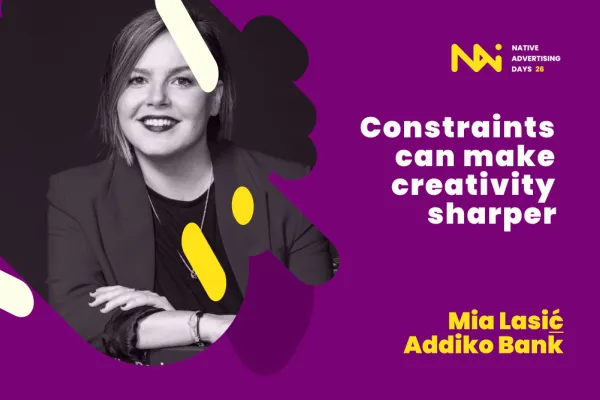
In the latest of our Speaker Spotlights, we spoke with Mia Lasić, who leads Marketing and Corporate Communications at Addiko Bank Hrvatska and champions the use of branded content in financial campaigns. Her expertise in banking communication offers a thought-provoking and creative perspective.
Mia will be leading a case track at Native Advertising Days if you’re keen to hear more from her experience after reading this - we certainly are!
Banking is one of the most regulated industries in the world. How do you balance creativity with compliance?
Well, this is one of the biggest challenges but also one of the reasons I find this job genuinely interesting.
Banking communication needs to be precise, compliant and transparent, especially when you're talking about products or financial decisions. But people today just don't consume information in "banking language" anymore. Attention spans are shortening, and the moment something feels too corporate or too complicated, they are gone.
So the real question isn't just how do you stay compliant, it's how do you stay compliant and still say something people actually want to hear?
At Addiko Bank, creativity is never about being flashy. It is about making complex topics feel understandable and culturally relevant. We previously had a whole campaign dedicated to translating banking jargon into plain, human language, because sometimes the biggest barrier between a bank and its customers is just the words we use.
As a smaller bank with around 6–7% market share in Croatia, we can't outspend the bigger players so we have to outthink them.
That's really where branded content became such a powerful tool for us.
The euro transition in Croatia was a huge national moment. What challenges did you face when communicating it?
The euro introduction was honestly one of the biggest communication challenges the Croatian banking sector had ever faced.
Every bank had a regulatory obligation to explain conversion rules, exchange rates, cash handling, and consumer protection. It’s all extremely important stuff, but it was typically communicated in a very dry, technical, boring way.
We wanted to do something different. Instead of a traditional corporate campaign, we created a satirical video series inspired by a beloved Croatian TV show from the 70s.
The main character was a barber, a guy who, in many ways, was still completely stuck in that era, trying to navigate all the funny and confusing situations around euro conversion: How to give back change? What if customers pay in cash? How do older generations react to something they never asked for?
His stubbornly old-school attitude made every interaction funnier, but also strangely relatable, because honestly, a lot of us felt a little lost during that transition too.
Why was branded content the right approach?
Because people remember stories. They don't remember instruction manuals.
Traditional banking communication tends to be very transactional: "here are the rules, please read the notice."
Branded content creates an emotional connection, and for smaller brands especially, that matters enormously. We need ideas people will voluntarily watch, share and talk about.
Humour was also a big part of it. The euro transition created genuine anxiety for a lot of people, and humour helped make the topic approachable, without making it feel trivial.
What started as a native video campaign ended up generating wider media coverage, TV discussions and really strong social engagement.
One of our proudest moments was receiving praise from the Croatian National Bank for communicating a complex national topic in a simple, engaging way. The campaign also picked up four awards at the 2023 Native Advertising Awards, plus several local industry recognitions.
One of your most interesting initiatives focused on financial literacy and the taboo around money in Croatia. How did that idea emerge?
It actually came from a pretty surprising research finding: Croatians have relatively good financial knowledge compared to the European average.
The problem wasn't knowledge, it was behaviour.
And behind that behaviour was something much more cultural: people in Croatia simply don't talk about money. Salary, debt, savings, investments, even within families or relationships, money is still an uncomfortable, almost shameful topic.
So instead of asking "how do we educate people more?" we flipped it and asked "how do we normalise conversations about money?"
That shift completely changed our whole approach.
What did the campaign look like in practice?
We built a platform designed to make conversations about money feel normal and approachable, not preachy.
Instead of traditional educational content, we leaned into conversation starters, such as quizzes connecting money to pop culture, influencer collaborations and relatable everyday financial situations. The kind of stuff that people actually engage with.
And we didn't just set a quiet internal target, we made a public pledge: to increase the percentage of Croatians who openly discuss money with their loved ones from 36% to 54% by 2028. We put that out there loudly and clearly, because accountability matters.
A year and a half after the initial research, we conducted a follow-up study to see where we stand, and the percentage increased to 41%. There’s still a long way to go, but for a shift in deeply rooted cultural behaviour, it’s a very meaningful and encouraging start.
What were the biggest insights from these campaigns?
There are three things I keep coming back to: People don't connect with financial jargon, they connect with human stories. Financial behaviour is far more emotional than rational.
And constraints, including regulation, can actually make creativity sharper and smarter if you let them.
What is your broader view on branded content today?
I think it's becoming more important than ever, especially for smaller brands and challenger players. In markets like Croatia, audiences immediately see through generic corporate communication.
They respond to authenticity, humour and cultural relevance. And for us, the biggest win wasn't the awards or the visibility (and don't get me wrong, we like awards a lot), but proving that even a bank can genuinely move a public conversation in a positive direction. That's the kind of impact that actually means something.
Get your tickets to hear more from Mia at Native Advertising Days.